

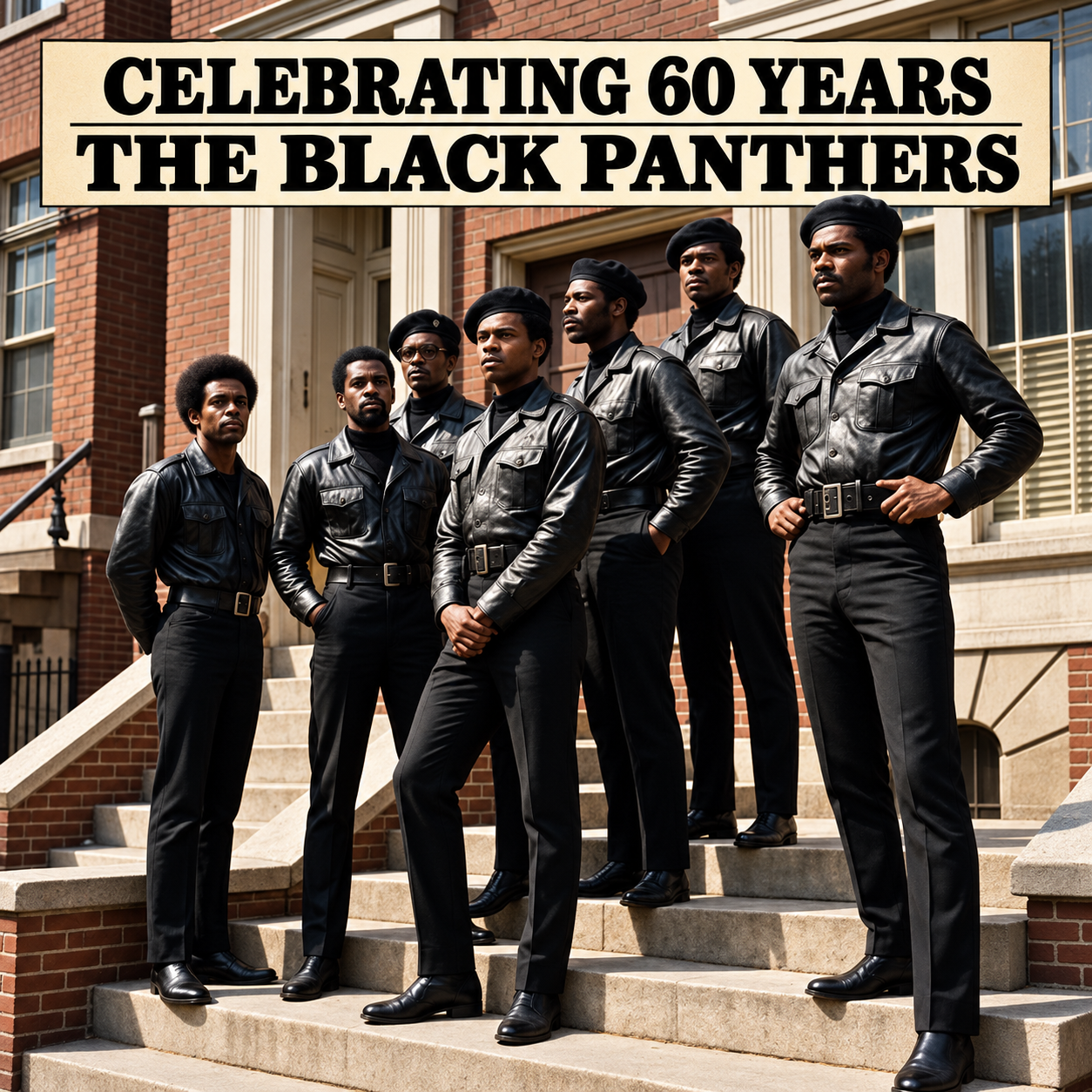

Sixty years ago today, on October 15, 1966, the Black Panther Party founded in Oakland, California, began a movement that would change Black America forever. Huey P. Newton and Bobby Seale named it the Black Panther Party for Self-Defense — a name that would become one of the most powerful in American history.
The Black Panther Party Founded in Oakland: Why They Started It
Newton and Seale weren’t responding to an abstract idea. They were responding to what they saw every day in Oakland: police brutality against Black residents with no accountability. Their answer was direct — Black communities had the right to defend themselves, and to watch the police who claimed to protect them.
That fall, at the North Oakland Neighborhood Service Center, they drafted the Ten-Point Program — “What We Want Now!” — demanding freedom, full employment, decent housing, education, an end to police brutality, and more. It was a platform written in plain language for the people it was meant to serve — and it remains the clearest statement of what the Black Panther Party founded in Oakland stood for.
More than the berets
The leather jackets, berets, and raised fists became the Party’s signature image. But the Panthers’ most lasting work looked very different.
The Black Panther Party founded in Oakland went on to build more than 65 community survival programs across the country. The Free Breakfast for Children Program, launched in 1969, fed thousands of hungry schoolchildren every morning. They ran free health clinics — including sickle cell anemia testing at a time when the medical establishment largely ignored the disease. They distributed food, offered transportation for the elderly, and ran community schools.
These programs embarrassed the government. Officials had to answer an uncomfortable question: if a group of young Black radicals could feed hungry children, why couldn’t the richest country on earth?
The crackdown
The federal government answered with force. The FBI’s COINTELPRO program made the Black Panther Party founded in Oakland a primary target for surveillance, infiltration, and disruption. Director J. Edgar Hoover called the Party the greatest threat to the internal security of the country.
The cost was devastating. Leaders were jailed on disputed charges. In December 1969, Chicago chairman Fred Hampton — just 21 years old — was killed in a predawn police raid while he slept. The Party that had survived street battles with police was slowly strangled by a government campaign designed to destroy it. By 1982, the Black Panther Party had officially folded.
Sixty Years Later: The Black Panther Party Founded in Oakland Endures
Today, Oakland is marking the anniversary the way it deserves. A four-day 60th anniversary conference and gala is underway in downtown Oakland, running October 15–18, bringing together Party veterans, scholars, activists, and a new generation. For the first time, the foundations carrying the legacies of both co-founders — the Dr. Huey P. Newton Foundation and the Bobby Seale Legacy Foundation — are working together to preserve the history. Oakland even renamed a stretch of Broadway in the Party’s honor.
And the story isn’t confined to history books. Decades after the Black Panther Party founded in Oakland disbanded, its name still makes headlines — from anniversary commemorations to present-day community defense efforts. Sixty years on, the Party’s example continues to inspire organizers who believe, as Newton and Seale did, that oppressed communities have both the right and the responsibility to care for themselves.
The legacy is everywhere once you know where to look. The free breakfast programs the Panthers pioneered became the model for the federal school breakfast program. Their sickle cell testing pushed a neglected disease into public view. Their Ten-Point Program’s demands — decent housing, real education, an end to police violence — are still the demands of movements today.
Sixty years after two young men in Oakland decided their community deserved better, the question the Panthers asked still hangs in the air: what does it look like when Black people organize to take care of their own?