

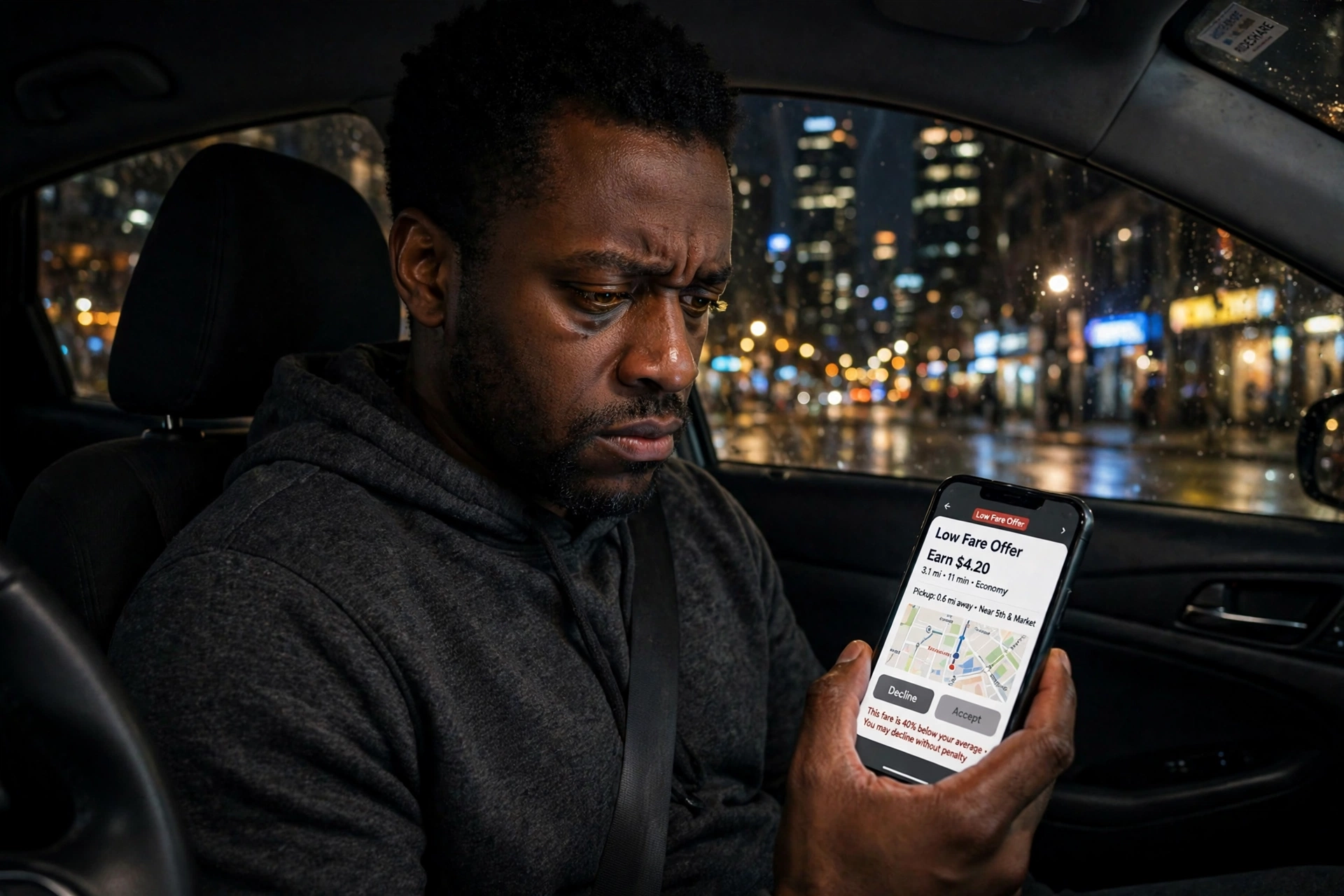

This is how Uber and Lyft driver pay works:rider pays $40, you get $17, and the app keeps the rest — and calls it a service fee.
That is not a glitch in the system. It is the system. Uber and Lyft built two of the most profitable companies in America on a simple trick: charge the rider one price, pay the driver a different one, and pocket the difference in the dark.
The split used to favor the driver
When rideshare started, drivers kept roughly 80 to 85 percent of every fare. The companies took a modest cut for matching rider to driver, and everybody understood the deal.
Then Uber went public in 2019. Then, in 2022, it rolled out “upfront pricing” nationwide. That was the break. Before upfront pricing, the rider’s fare and the driver’s pay came from the same formula. After it, they didn’t. The rider sees one number, generated by an algorithm. The driver sees a take-it-or-leave-it offer. The spread between those two numbers belongs to the company — and the company never shows you the rider’s number.
The results are now documented. Columbia Business School researcher Len Sherman found Uber’s share of each fare rose from 32 percent in 2022 to 42 percent by the end of 2024. Consumer Reports, testing routes in 18 states, found that between 43 and 49.5 percent of each fare goes to the companies. An analysis of Oregon ride data by Princeton’s Workers Algorithm Observatory put Uber’s cut at 44 percent and Lyft’s at 52 percent. Sherman’s analysis of roughly 50,000 trips from veteran drivers in Dallas, Miami, and Tampa found Uber’s take crossing 50 percent in those markets — a decade ago it was 15 to 20 percent.
Meanwhile, Uber’s profits from ride-hailing nearly quadrupled, from almost $2.1 billion in 2019 to nearly $7.9 billion in 2025. Lyft went from losing about $679 million in 2019 to profiting nearly $529 million in 2025. The drivers got the algorithm. The shareholders got the money.
Uber Lyft driver pay: what drivers actually take home
The companies love to quote gross hourly numbers. The net numbers tell a different story.
Gridwise’s analysis of 2025 earnings found Uber drivers grossing a median of $21.92 an hour and Lyft drivers $22.45 — before expenses. After expenses, that falls to somewhere between $8 and $12 an hour. A 2024 UC Berkeley Labor Center study of drivers in five large metro areas found median take-home pay, without tips, of less than $6 an hour once gas, maintenance, and all hours spent driving — including time waiting without a passenger — were counted.
Sherman’s newest study, covering 1.8 million Uber trip offers from March 2025 to March 2026 across 16 cities, found net pay ranging from $3.18 an hour in Orlando to $21.87 in Boston. In six of those 16 cities, drivers’ estimated net pay fell below the federal minimum wage of $7.25 an hour.
Read that again: in more than a third of the cities studied, people driving strangers around in their own cars, on their own gas, were netting less than minimum wage.
The driver pays for everything
Here is the part the ads never mention. The driver brings the car. The driver buys the gas. The driver pays for the oil changes, the tires, the brakes, the depreciation that piles up at a rate no office job would ever ask a worker to absorb. The IRS standard mileage rate — its own estimate of what driving a mile actually costs — is 76 cents a mile for the second half of 2026. Every mile a driver spends deadheading to a pickup, unpaid, comes out of that same pocket.
Then there is the tax bill. Drivers are independent contractors, so nothing is withheld. They owe 15.3 percent in self-employment tax on top of income tax. There is no employer health insurance, no paid sick leave, no workers’ compensation if a passenger assaults you or a crash puts you in the hospital. The companies call this “flexibility.” What it really means is that every cost of doing business has been pushed onto the worker, while every lever of control — the price, the dispatch, the deactivation — stays with the company.
They were caught lying about the pay
This is not speculation. In October 2024, the Federal Trade Commission fined Lyft $2.1 million for misleading drivers about how much they could earn. Lyft’s ads promised drivers could make “up to” $33 or $37 an hour in some cities. The FTC found those figures were based on what the top 20 percent of drivers made — meaning most drivers could never expect them — and that the numbers were inflated by as much as 30 percent, partly by quietly including passengers’ tips in the “pay” figure.
Lyft’s “earnings guarantees” were worse. Drivers were led to believe a guarantee — say, $975 for completing 45 rides in a weekend — was a bonus on top of their earnings. It wasn’t. It was a conditional minimum: Lyft only paid the difference if the driver fell short. Tens of thousands of drivers complained. Lyft settled without admitting or denying wrongdoing, and was ordered to base pay claims on typical drivers’ earnings, not the top fifth.
When a company like Uber has to be fined by the federal government to stop exaggerating what its workers earn, that tells you everything about the business model.
The proof that it is a choice
If anyone tells you there is no other way to run rideshare, look at Massachusetts. In June 2024, after the state sued Uber and Lyft for treating drivers as contractors while denying them employee protections, the companies agreed to pay $175 million — $148 million from Uber, $27 million from Lyft — mostly as restitution to drivers who had been underpaid. They also agreed to a pay floor of $32.50 an hour for time spent en route to pickups and carrying passengers, a rate that has since risen to $34.48 with inflation, plus paid sick leave and a health care stipend.
Notice what happened in Sherman’s city-by-city study: Boston, under that Massachusetts pay floor, had the highest net driver pay in the country at $21.87 an hour. Orlando, with no floor, had the lowest at $3.18. The pay gap isn’t an accident of the market. It is a policy choice, and where the law forces a fairer split, drivers do dramatically better.
The drivers noticed. In May 2026, Massachusetts rideshare drivers formed the first rideshare union in the United States, with roughly 32,000 of the state’s 70,000 drivers signing on. California followed with legislation signed in October 2025 setting up a path for its drivers to unionize too.
What the companies say
Uber disputes the independent studies, saying its U.S. take is around 20 percent after insurance costs, which it says can eat 14 to 31 percent of a fare depending on the state. Lyft says most of its drivers are part-time and value the flexibility to set their own hours.
Fair enough — insurance is a real cost, and flexibility is real. But neither answer explains why the driver’s share of the fare has fallen by half since the early days, why rider prices keep climbing while driver pay falls, or why the companies fought so hard — spending more than $200 million to pass California’s Proposition 22 in 2020 — to keep drivers classified as contractors rather than employees with a wage floor.
The bottom line
A taxi driver once kept most of the meter. A rideshare driver today is lucky to keep half the fare, pays all the costs, gets none of the benefits, and can be cut off by an algorithm with no appeal. The rider pays more than ever. The driver takes home less. The difference flows upward, billions of dollars of it, to companies that own no cars and employ no drivers.
That is not innovation. That is a robbery with better branding — and drivers across the country are finally organizing to take their pay back.