

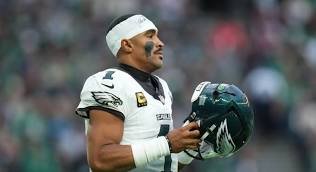

Jalen Hurts’ season is over — and for once, football is the least important part of the story.
The Philadelphia Eagles announced Monday that further testing on their franchise quarterback revealed deep vein thrombosis and bilateral pulmonary emboli — blood clots in both of his lungs. Jalen Hurts’ agent, Nicole Lynn, said in a statement that he is clinically stable, has no significant functional limitations, and will be treated with blood thinners, which means he can’t do any contact activities while on them.
ESPN’s Adam Schefter and NFL Network’s Ian Rapoport both reported that Jalen Hurts will miss the rest of the 2026 season, with treatment expected to run about three months. The team stopped short of formally shutting him down, but with blood thinners in the picture, he won’t play again this year.
How a calf injury became a season-ending scare
Jalen Hurts was cleated in the leg during the Eagles’ October 4 loss to the Los Angeles Rams. On October 8, he told the training staff about a calf injury from that kick. He practiced, then flew to London with the team for the game against Jacksonville.
In London, an ultrasound found a superficial blood clot in his left calf. Doctors there concluded that activity and mobility were important and that Hurts could safely play. Rapoport reported that Hurts spent the night before the game in the hospital until around 3 or 4 a.m. and went without sleep because sleep itself was considered a risk.
He played anyway. The Eagles lost 19-17 to the Jaguars on October 11, and Hurts took the field noticeably later than his teammates.
Back in Philadelphia, the Eagles placed him on injured reserve on October 17 — a minimum four-game absence. Then came the weekend imaging, and Monday’s announcement: the clots had traveled to his lungs.
What the diagnosis actually means
Deep vein thrombosis is a clot that forms in a deep vein, usually in the leg. A pulmonary embolism is what happens when part of that clot breaks off and travels to the lungs — and it can be life-threatening if untreated. Hurts has both, in both lungs.
Treatment is anticoagulation—blood thinners—which stop clots from growing while the body breaks them down. The catch for an athlete is obvious: on blood thinners, contact is off the table because of the risk of bleeding. That’s why a “very good” prognosis still costs him the season.
The encouraging part is real, though. Both the team and Lynn stressed that Jalen Hurts is stable, functioning normally, and expected to fully recover with no long-term effects. He’ll stay around the team and keep conditioning while he recovers.
The questions the Eagles still have to answer
Here’s where the story turns from medical to uncomfortable.
Jalen Hurts played an NFL game — after a transatlantic flight, on no sleep — eight days after reporting a calf injury and one day after an ultrasound found a blood clot in that calf. The Eagles have released two statements in four days in the name of transparency, but as CNN’s analysis put it, the situation leaves the team with tough questions about how a quarterback with a known clot was cleared to play, and whether the follow-up came fast enough.
Maybe every decision was defensible in the moment. But when a 28-year-old Super Bowl MVP ends up with clots in both lungs, “the doctors cleared him” is going to be examined line by line — by the league, by the players’ association, and by every other player watching how a franchise handles a star’s health scare.
What it means for the Eagles
On the field, Philadelphia is in trouble. Backup Tanner McKee started Sunday, and the Eagles lost 25-14 at home to Carolina — their fourth straight loss, dropping them to 2-4.
Jalen Hurts finishes his season with five starts: 933 passing yards, eight touchdowns and three interceptions. The career résumé he’s putting on hold is a heavy one — a three-time Pro Bowler, the MVP of Super Bowl LIX, a 59-28 record as a starter, 118 passing touchdowns and 64 more on the ground.
For more of our sports coverage, read why LeBron James should be celebrated in the Black community.