

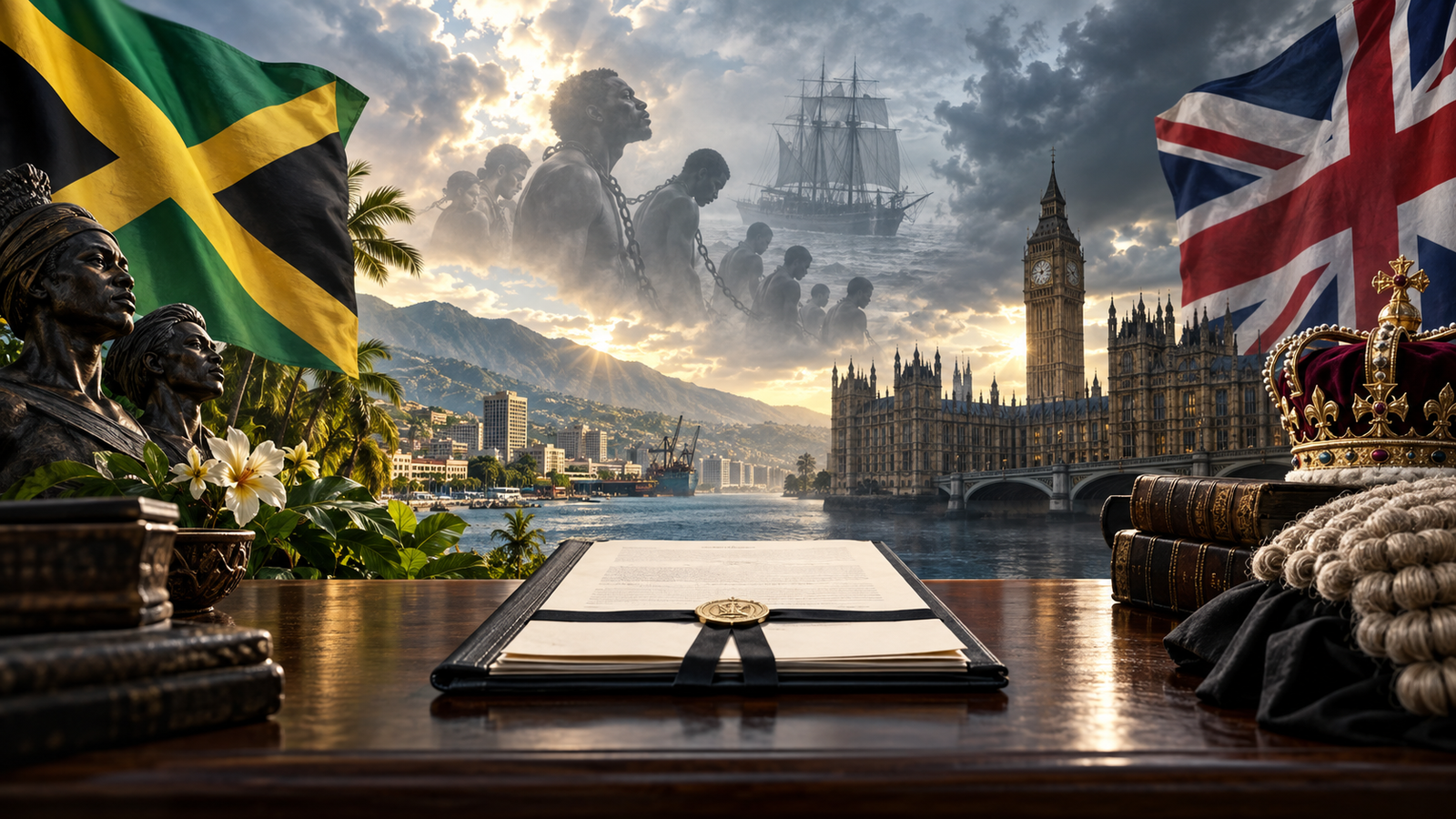

On September 7, 2026, Jamaica formally petitioned King Charles III to refer questions concerning Britain’s role in slavery to the Judicial Committee of the Privy Council.
The petition, filed on behalf of the Jamaican people by Attorney General Dr. Derrick McKoy, asks the court to determine whether the forced transportation and enslavement of Africans in Jamaica was ever legal under English law.
It also asks whether Britain violated international laws against slavery, torture, racial discrimination and crimes against humanity—and whether the United Kingdom now has a legal obligation to provide reparations to the Jamaican people.
This is different from another political speech or symbolic demand for an apology. Jamaica is attempting to move the reparations debate into a legal forum.
According to the petition, approximately 1.2 million kidnapped Africans were transported to Jamaica during the transatlantic slave trade. They were forced to work primarily on British-controlled sugar plantations while enormous wealth flowed out of the island.
Britain abolished slavery throughout most of its empire in 1834, but formerly enslaved Jamaicans were forced into an “apprenticeship” system that continued until 1838. Britain compensated slave owners for the loss of their so-called property. The people who had been enslaved received nothing.
Jamaica’s petition argues that the damage did not disappear when slavery officially ended. The country continues to live with economic and social conditions created by centuries of enslavement and colonial rule.
The filing occurred on the anniversary of the 1781 voyage of the Zong, a British slave ship connected to one of the most horrifying crimes of the transatlantic slave trade. During that voyage, more than 130 captive Africans were thrown overboard so the ship’s owners could attempt to collect insurance money. The dispute that followed was handled as a property and insurance matter—not as a mass murder case.
The British government has resisted demands for reparations, maintaining that historical actions should be considered under the laws that existed at the time. Jamaica’s petition directly challenges that defense by asking whether slavery was actually lawful under English legal principles in the first place.
King Charles has not agreed to refer the questions to the Privy Council. Even so, Jamaica has placed the issue before the British Crown in a way that cannot easily be dismissed as nothing more than political rhetoric.
The question is no longer simply whether slavery was morally wrong. No serious person disputes that.
The question Jamaica is now asking is whether Britain can be held legally responsible for the wealth it extracted, the lives it destroyed and the damage that continues generations later.
Read Jamaica’s official petition.
Black Perspective News — Our Perspective Counts.