

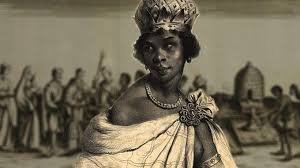

Queen Nzinga — The African Queen Who Defied Europe
Long before modern conversations about resistance, liberation, and women in leadership, there was Queen Nzinga of Ndongo and Matamba — one of the most formidable political and military leaders in African history. In the 17th century, while European powers expanded aggressively across Africa, Nzinga stood as a barrier between colonial domination and her people’s freedom.
Her story is not just one of survival, but of brilliance, courage, and strategic mastery.
Early Life and Rise to Power
Queen Nzinga Mbande was born around 1583 into the royal family of Ndongo, a kingdom in present-day Angola. She grew up during a period of intense conflict as Portuguese forces sought control of the region for territory and enslaved labor.
Unlike many women of her time, Nzinga received training in diplomacy, leadership, and warfare. She quickly proved herself as an exceptional negotiator and strategist.
In 1622, she represented her brother, the king, in peace negotiations with the Portuguese — a meeting that would become legendary.
When Nzinga entered the negotiation room, Portuguese officials refused to offer her a chair — an intentional insult meant to force her to sit below them.
Refusing humiliation, Nzinga ordered one of her attendants to kneel on the floor and sat on the attendant’s back, placing herself at eye level with the governor.
The message was clear: She would negotiate as an equal, not a subordinate.
Warrior Queen Against Colonial Power
After her brother’s death, Nzinga took the throne in 1624. Her reign would become one of the longest and most effective resistance movements against European expansion in Africa.
She led armies personally, coordinated military campaigns, and used guerrilla warfare to frustrate Portuguese forces. When necessary, she relocated her capital and reorganized her defenses rather than surrender.
Nzinga also formed alliances with neighboring groups and even the Dutch — enemies of Portugal — to maintain independence.
Protector of Her People
Queen Nzinga became a refuge for those fleeing slavery. Escaped captives, displaced communities, and soldiers found protection within her kingdom of Matamba, which she transformed into a powerful regional state.
She understood that population meant power. By sheltering refugees, she strengthened both her military and economic base.
Diplomat, Strategist, and Survivor
Nzinga’s leadership was defined by flexibility and intelligence.
At one point, she converted to Christianity to secure a peace treaty with Portugal, adopting the name Dona Ana de Sousa. Later, when relations deteriorated, she returned to traditional spiritual practices and renewed resistance.
Her ability to shift strategies — from diplomacy to warfare — kept her kingdom independent for decades.
Legacy of a Fearless Leader
Queen Nzinga ruled until her death in 1663 at around 80 years old — an extraordinary lifespan for a wartime leader in that era.
Today, she is remembered as:
- A symbol of African resistance to colonization
- A pioneer of female political and military leadership
- A national hero in Angola
- An icon of Black strength and sovereignty
Her legacy continues to inspire movements for freedom, dignity, and self-determination worldwide.
Why Queen Nzinga Still Matters Today
In an age where history often overlooks African women leaders, Nzinga’s story stands as undeniable proof that powerful, strategic, and visionary leadership has always existed on the continent.
She did not merely survive colonial pressure — she reshaped the political landscape of Central Africa and protected her people from one of history’s most destructive systems.
Queen Nzinga’s life reminds us that resistance is not only fought on battlefields but also at negotiation tables, in alliances, and through unwavering belief in sovereignty.