

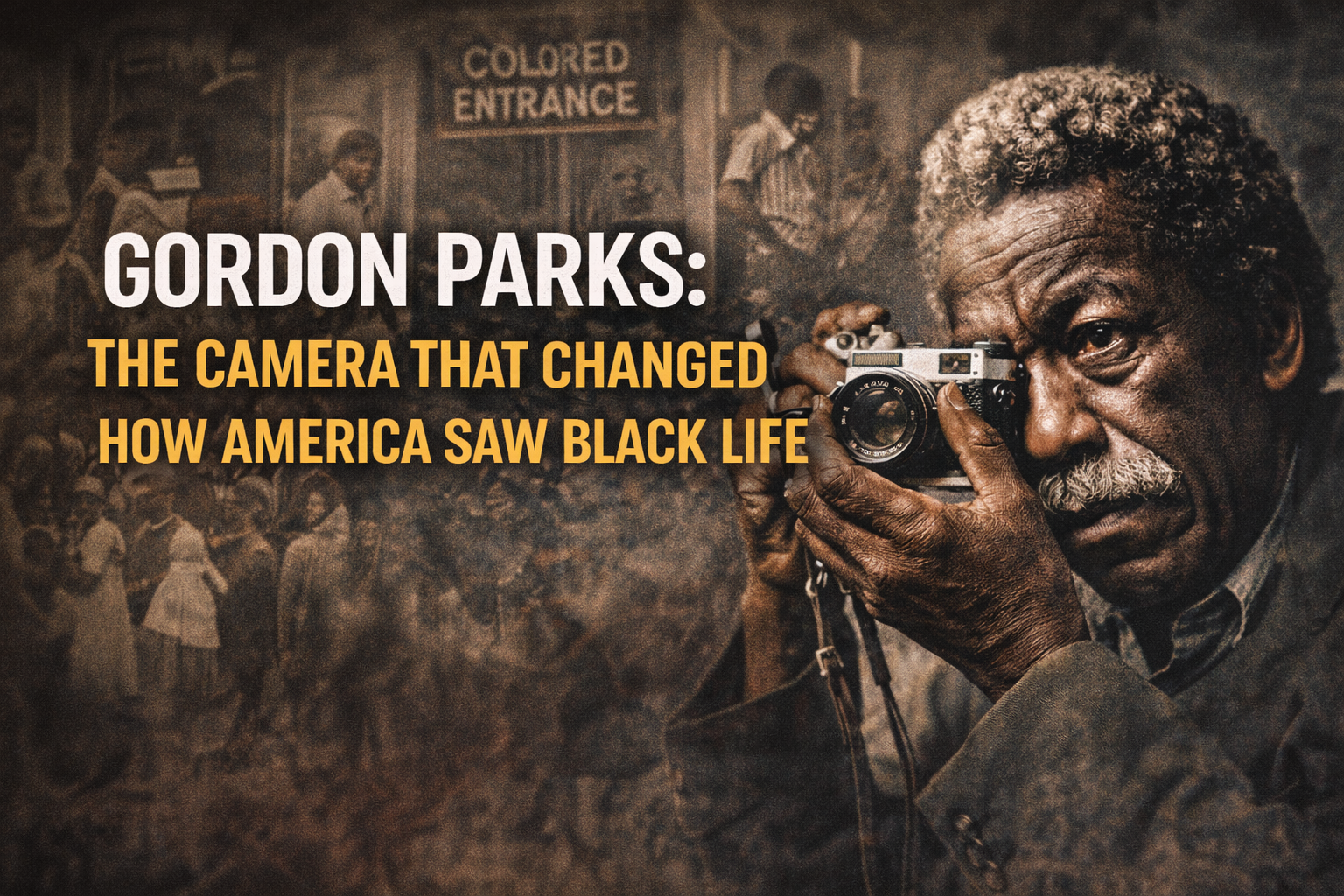

Gordon Parks didn’t just document Black life — he redefined how America saw it.
Born in 1912 and raised in poverty, Parks taught himself photography and went on to become the first Black photographer for Life magazine. During a time when Black individuals were frequently depicted through stereotypes or completely erased, Parks emphasized the importance of portraying truth, dignity, and humanity.
His images exposed segregation, poverty, and racism without sensationalism. He photographed everyday Black families with care, showing struggle without stripping people of pride. One of his most famous works, American Gothic, Washington, D.C., captured a Black cleaning woman standing before an American flag — a quiet but devastating critique of inequality in the nation’s capital. But Parks didn’t stop at photography.
Gordon Parker became the first Black filmmaker to direct a major Hollywood studio film. In the movie Shaft (1971), Parks helped change how Black men were portrayed on screen. The movie didn’t show a side characters or caricatures, but as confident, complex leads.
Parks once said:
“I chose my camera as a weapon against poverty, racism, and all sorts of social wrongs.”
That wasn’t a metaphor. His work challenged power structures, influenced public opinion, and forced America to confront realities it preferred to ignore.
Why Gordon Parks Still Matters
In today’s world of viral videos and fleeting outrage, Gordon Parks reminds us that representation without intention is empty. His work wasn’t about attention — it was about accountability.
He understood that images shape narratives, and narratives shape policy, memory, and power.
Gordon Parks didn’t just change photography or film. He changed who was allowed to be seen.